In this article
Planning a trip in an electric car does not end with checking the range. It is just as important to know what you will use to charge the car once you get there. In practice, most problems do not come from a lack of chargers nearby, but from mismatched equipment: the hotel has a wallbox without a cable, the guesthouse offers a regular socket, and behind the campsite there is only a red industrial outlet.
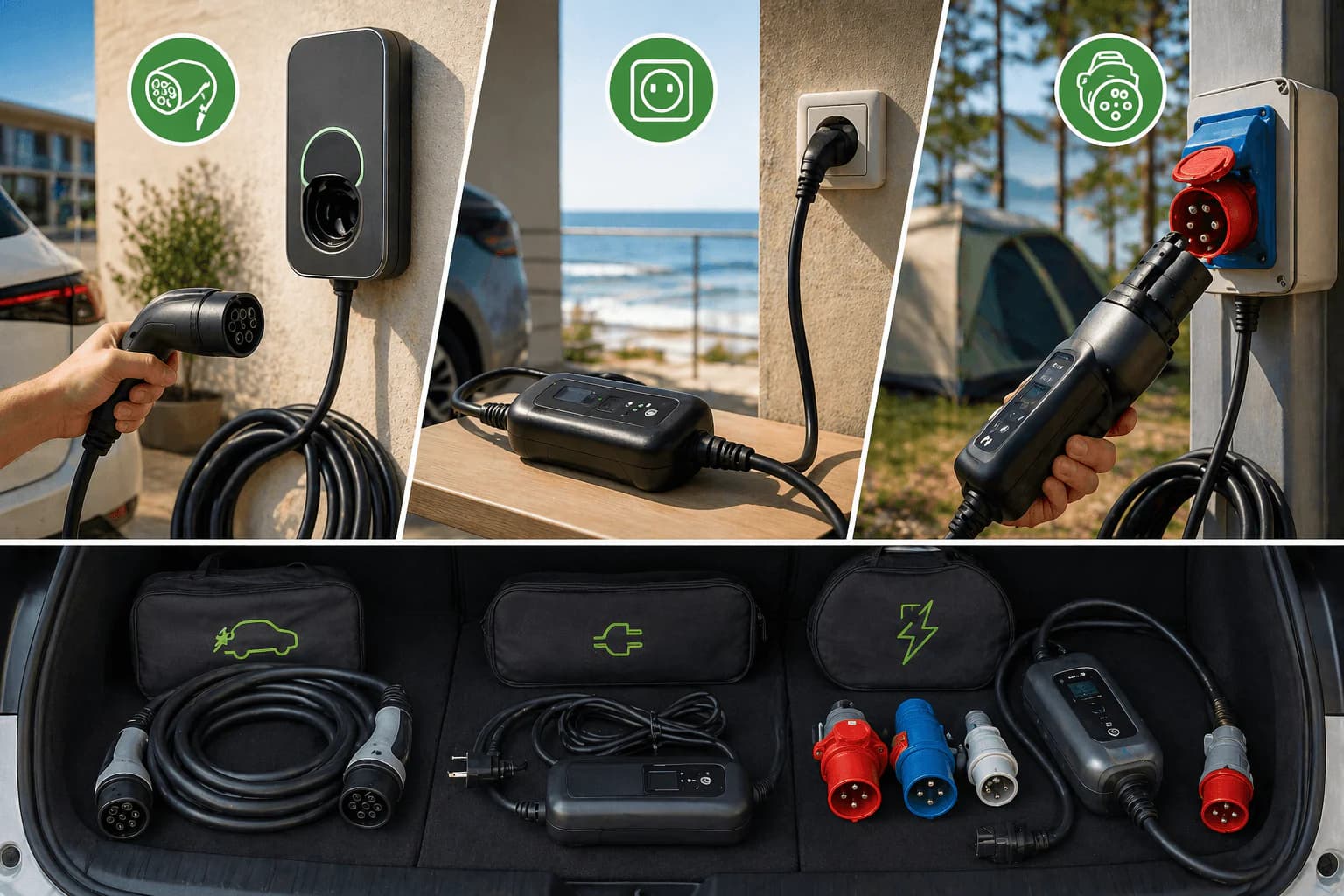
That is why a sensible EV driver’s travel kit should be built around three things. Not everyone needs all of them right away, but it is worth knowing what truly provides peace of mind on the road and what is only an extra.
1. Type 2 cable: the absolute minimum in the trunk
If you take only one thing, let it be a Type 2 cable. It is the basic piece of equipment for trips, because many hotels and quite a few public AC charging points provide only the socket, without a permanently attached cable.
In practice, it looks like this: you pull up to a sleek wallbox, everything seems fine, but without your own cable you cannot do anything. This is a common scenario, especially where a property offers AC charging at 11 kW or 22 kW, but leaves it up to the driver to connect their own cable.
When a Type 2 cable is essential
- when the hotel has a wallbox with a socket, not a tethered cable,
- when you use public AC socket-type stations,
- when you want a universal solution for most everyday charging situations on the road.
What to look for when buying one
Not every cable will be equally practical. It is worth checking:
- power and number of phases — ideally, buy a cable compatible with three-phase charging if your car supports it,
- length — 5 m is usually enough, but 7 m gives you more flexibility in tight parking spaces,
- plug quality and cable durability — a cheap cable quickly shows its weaknesses when it is frequently coiled up and carried in the trunk,
- a cover or bag — a small detail, but a wet and dirty cable thrown loosely into the car gets annoying fast.
For many drivers, their own cable solves 80% of EV charging problems at hotels. Without it, even a well-prepared property can turn out to be useless.
2. 230V EVSE brick: a lifeline, not an everyday strategy
The second item is a 230V EVSE charger, commonly called a brick. This is a device for charging from a standard household socket, usually Schuko. It does not provide much power, but it can be invaluable when there is nothing better available.
That said, it is worth stating clearly: a brick is not the right solution for every place and every electrical installation. It is more of a backup plan than a convenient method for regular overnight charging.
When a brick makes sense
- at a guesthouse where the owner agrees to charging from a solid socket,
- at a farm stay or holiday cottage where there is no wallbox,
- as a backup when all other options fail.
With 230V charging, energy recovery is clearly slower than with 11 kW AC. Overnight, it is often enough to add a reasonable reserve, but it will not always take the battery from empty to full. A lot depends on the car, the current setting, and the quality of the installation.
The most important thing: safety
This is where it is easiest to make an expensive mistake. Do not plug an EVSE brick into random, weak hotel extension cords. A thin cable wound on a reel, an old power strip, or a loose socket is asking for overheating.
Safer rules are simple:
- use only a reliable, verified socket,
- if the EVSE allows it, set a lower current, such as 8A or 10A, if the installation raises doubts,
- do not use cheap adapters of unknown origin,
- do not leave improvised connections in a place exposed to rain or accidental disconnection,
- always agree the charging arrangement with the property staff.
A good EVSE brick has protections and gives you more control than improvised solutions, but it still depends on the quality of the existing installation. If a hotel says only, please plug in somewhere behind the building, it is worth asking which exact socket they mean.
3. Mobile charging station: the most expensive, but the most reassuring option
The third level of preparation is a mobile EV charging station, for example Juice Booster, Green Cell Habu, or Zencar. This solution is more expensive than a standard brick, but also much more versatile. In practice, for people who travel often, it can be the best insurance policy.
Its biggest advantage? With the right tips and adapters, such a station can work with different power sources. That means you are not limited to Schuko alone.
Where a mobile station really saves the day
The most common scenario looks like this: the hotel does not have a standard EV charging point, but the staff say you can use the red industrial outlet in the back. In that case, a regular brick will not help, while a mobile station may allow for meaningful charging.
This usually means CEE 16A or CEE 32A outlets, the so-called industrial power sockets. With the right equipment and compatibility with the car, this is no longer emergency trickle charging, but normal, useful charging.
What a mobile station gives you
- support for different types of power supply,
- the ability to charge where there is no wallbox,
- more flexibility at campsites, guesthouses, and technical facilities,
- better use of places that are not formally charging stations but do have the right infrastructure.
What to keep in mind
This is not a purchase to make blindly. Before spending more money, check:
- which car charging adapters are available and certified,
- whether the device has solid temperature and surge protection,
- whether your car can use the available AC power,
- how resistant the equipment is to water, dust, and everyday transport.
It is also worth using common sense: the mere existence of an industrial outlet does not automatically mean permission to charge. A hotel kitchen back area, workshop, or technical zone are places where staff must consciously allow you access.
What to pack if you want to be really well prepared
Not everyone needs a full set right away. A sensible order is usually this:
Basic set
- Type 2 cable,
- gloves or a cloth for dirty cables,
- a cable bag.
Extended set
- Type 2 cable,
- 230V EVSE brick,
- a short, solid extension cord only if the manufacturer explicitly allows it and the cable has the proper conductor size.
Set for frequent travelers
- Type 2 cable,
- EVSE brick,
- mobile charging station,
- a set of necessary adapters,
- a label or organizer so you do not have to fumble around for the right tip on the road.
The most common mistake: buying equipment instead of checking the location
Equipment gives you independence, but it does not solve everything. You can have a trunk full of electric car accessories and still get stuck if, once you arrive, it turns out that:
- the hotel parking lot is locked at night,
- the socket is too far from the parking space,
- charging works only with prior reservation,
- the wallbox exists, but is temporarily out of order,
- the property does not allow the use of technical sockets.
That is why, before a trip, it is worth knowing not only whether the hotel has charging, but also what type of charging point it is. That makes a huge difference.
If a wallbox with a tethered cable is waiting on site, you arrive and charge. If there is only a Type 2 socket, you will need your own cable. If the property offers only Schuko or industrial power, then a brick or a mobile station becomes useful.
A sensible conclusion before you hit the road
The safest option is simple: a Type 2 cable is a must, an EVSE brick is a backup plan, and a mobile charging station is equipment for those who want to be ready for almost any infrastructure surprise.
A trunk full of adapters really can save a trip. But even better is knowing in advance what will be waiting for you on site. Instead of guessing, check the property on ChargeAndSleep.com — you will immediately see whether the hotel offers a wallbox with a cable, only a Type 2 socket, or just access to industrial power or Schuko. Then you pack exactly what you need, not half an accessories store.
Next trip
Compare hotels before you lock dates
Browse hotels with power and connector filters. EV Trust and stall specs when we have them.