In this article
Your first longer trip in an electric car can feel more stressful than the vacation itself. It is easy to imagine the worst-case scenario: a traffic jam, a detour, kids asking every five minutes, and the battery dropping faster than the brochure promised.
The good news is simple: you do not need to plan your trip with Excel in hand. In practice, one rule and two sensible steps are enough.
The 80/20 rule: do not overcomplicate it
For your first EV vacation, the 80/20 approach works best.
That means:
- 80% of your peace of mind comes from a simple plan, not a perfect schedule for every stop
- 20% is adjustments on the way: weather, traffic, driving pace, a spontaneous coffee, or a change of plans
You do not need to know exactly where you will stop down to the kilometer. You only need to plan two things:
- Where you will top up quickly on the road
- Where you will charge calmly overnight at your destination
If you leave the hotel in the morning with the battery close to 100%, half the stress disappears immediately.
The most important mindset shift: you are not driving from zero to zero
New EV drivers often try to think about a route the same way they would in a gasoline car: drive until you are almost empty, then refuel and keep going. In an EV, that is usually not the best model.
On the road, a different rhythm works better:
- start with a high battery level
- one or two sensible stops for fast DC charging
- overnight charging where you stay
This matters because fast charging is fastest mainly when the battery is not already very full. That is why it is often better to charge from around 15-20% to 70-80% than to wait a long time to reach 100% by the roadside.
You do not need to know all the battery physics. Just remember one thing: on a trip, you rely on short, practical stops, and full charging is best done while you sleep.
Planning your route in two steps
Step 1: fast charging on the way
These are stops along your route, ideally ones that make sense anyway: lunch, a restroom break, coffee, stretching your legs.
Look for DC chargers, meaning fast chargers. For a beginner, that is the simplest rule.
What to check:
- whether the station is close to the main route, not 20 minutes off the way
- whether it has more than one charging point
- whether there is something normal nearby to wait it out: a restaurant, shop, restroom
- whether there are recent user reviews
- whether the operator is reliable and not known for frequent outages
On your first trip, do not plan a route with no margin. Leave yourself a buffer.
It is safer to assume you will reach the charger not with 2%, but rather with:
- 15-20% on an easy route
- 20-25% if you are driving on the highway, it is cold, it is raining, or the car is heavily loaded
That is not excessive. It is simply a safety margin.
Step 2: destination charging, meaning a stay with electricity
This is where the real magic of relaxed travel happens. If the hotel, guesthouse, or apartment has a real, usable charger, you leave in the morning with a full or nearly full battery. Suddenly, the next day stops being a logistical puzzle.
That is why charging on vacation is worth treating not as an extra, but as part of your accommodation. Just as important as parking or breakfast.
The right question is not: does the property have something for charging?
It is better to ask:
- what exact type of charging it is
- what the power output is
- whether the charging point is available to hotel guests
- whether you need to reserve a spot in advance
- whether charging is paid, and if so, under what rules
- whether someone has actually used it and confirmed that it works
Not every stay with a charging station really solves the problem
This is where beginners most often get caught out.
On large booking platforms, the charging station filter is often too broad. In practice, it may mean:
- a regular 230 V socket in the garage
- a single industrial socket with no clear rules for use
- a wallbox that exists but has not worked for months
- a charger available only to selected guests or only by prior arrangement
And a regular socket will not always save the situation. Overnight, it may recharge only part of the battery. Sometimes that is enough, and sometimes it is not. If you are counting on a full car in the morning before continuing your trip, the disappointment can be painful.
That is exactly why blindly trusting the filter alone is a bad idea.
How to check a hotel with a charger without guessing
The safest approach is simple:
- Find accommodation that declares charging is possible
- Check exactly what kind of charging point it is and what the power is
- Look at recent reviews from EV drivers
- Confirm with the property that the spot will be available on your arrival day
- If this is a key part of your trip, choose a place already verified by others
This is exactly where ChargeAndSleep.com comes in handy. Instead of guessing whether a hotel is really suitable for an EV driver, you can rely on places verified by the community. For a newcomer, it works like an insurance policy: fewer surprises, a calmer evening, and a better chance of setting off in the morning with a full battery.
How much you really need to plan before leaving
Less than you think.
For your first EV trip, it is enough to prepare:
- your starting point: ideally leaving with a charged car
- one main DC charging stop on the way
- one backup DC charging stop, in case the first one is occupied or out of service
- accommodation with confirmed charging
That is already a good plan.
You do not need a list of seven alternative stations and a table of battery percentages every 40 kilometers. The simpler the plan, the easier it is to stick to.
How to plan an EV route without technical jargon
If you are just getting started, stick to a few simple rules.
Drive a little slower than your right foot suggests
At higher speeds, energy consumption rises noticeably. The difference between calm driving and constantly pushing in the fast lane can be bigger than it seems.
On vacation, saving 10-15 minutes is often not worth the extra stress about EV range on the road.
Treat the range estimate as guidance, not a promise
The real result depends on, among other things:
- speed
- wind
- rain
- temperature
- luggage and number of passengers
- a hilly route
If the car shows that you will arrive with 8%, do not assume that is guaranteed. It is better to keep a buffer.
Charge when you are taking a break anyway
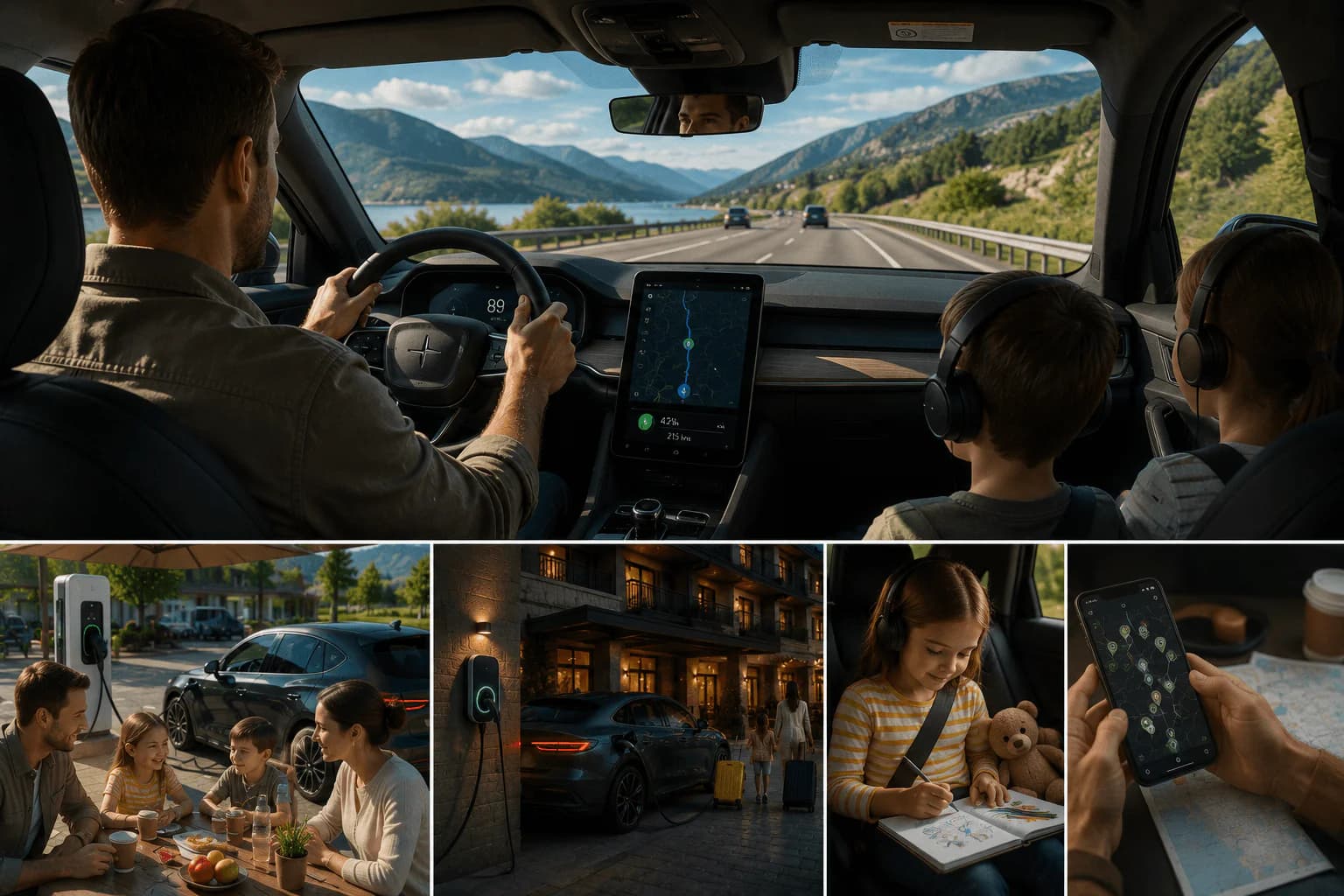
This is the simplest way to make EV travel feel less like a series of technical stops. Lunch, coffee, a playground, walking the dog — if the car can fast-charge at the same time, nobody feels like they are waiting just for the cable.
Do not fight for 100% at a fast charger by the road
At a transit stop, it usually makes more sense to leave earlier and top up once more later than to wait a long time for the last few percent.
Save full charging for your overnight stay.
What apps are worth having as an EV driver
You do not need to install everything. For your first trip, three types of tools are useful:
- a route-planning app that includes charging
- apps from charging operators you are likely to use on the way
- a place to check accommodation with real charging, not just a marketing label
It is also a good idea before leaving to:
- create accounts in the apps you need
- add a payment card
- check that login works
- have internet on your phone and a cable to charge your phone in the car
It sounds trivial, but a lot of stress comes not from the car battery, but from someone standing at the charger and only then creating an account.
A simple scenario for your first vacation route
Let us say you have about 450-500 km ahead of you.
A sensible plan might look like this:
- leave in the morning with the battery charged to 100%
- after 2-3 hours, stop for fast DC charging during lunch
- arrive at your accommodation with a safe buffer
- plug the car in overnight at the hotel
- leave in the morning with a full or nearly full battery
And that is it.
There is no trick here. It is simply a calm routine. That is exactly how a first EV trip stops feeling like an exam and becomes a normal journey.
What to tell your passengers to avoid tension
It is a small thing, but it works.
Instead of saying:
- we have to stop because the battery is running low
it is better to say:
- we are stopping for lunch in a moment, and the car will top up while we eat
The difference is huge. For passengers, the stop stops being a technical problem and becomes a natural part of the trip.
If you are traveling with family, it is good to set one simple rule right away: we plan stops where we can eat something, use the restroom, and rest for a bit. Then charging does not compete with travel comfort — it supports it.
The most common beginner mistakes
An overly ambitious plan with no margin
If everything only works out in perfect weather and on an empty road, the plan is too tight.
Choosing a hotel without checking what charging actually means
A declaration on the property website is not enough. Details and confirmation are what matter.
Assuming every fast charger on the way will be free and working
That is why it is worth having one sensible plan B.
Trying to copy habits from a gasoline car
In an EV, several shorter, natural stops usually work better than waiting until the last moment.
Nervously checking the battery percentage every five minutes
That is exactly why you have a simple plan. The goal is to arrive calmly, not to run an all-day investigation on the screen.
If you are renting an EV for your vacation
There is one more thing here: get to know the car before the trip.
Before you leave, check:
- roughly what its real highway range is
- how to start charging
- which connectors it supports
- whether the AC charging cable is in the car
- how the navigation and charger search work
Do not assume every EV behaves the same way. Differences between models are normal. It is better to spend 15 minutes calmly getting familiar with the car than to learn everything at the first charger.
The simplest recipe for a vacation without range anxiety
If you want to remember only one version of this guide, let it be this:
- start with a full battery
- on the road, charge quickly and during breaks
- for the night, choose accommodation with reliable charging
- leave yourself a buffer and a plan B
- do not trust the charging station filter without checking
And if you want to take the biggest burden off your shoulders, start with the accommodation. A verified hotel with a charger makes a bigger difference than many drivers expect before their first trip.
That is exactly why it is worth checking ChargeAndSleep.com. When the community has already checked the hotel for you, it is easier to sleep peacefully and easier to leave in the morning without stress. For a beginner EV driver, that is not a luxury. It is simply a sensible safeguard for a first vacation.
Next trip
Compare hotels before you lock dates
Browse hotels with power and connector filters. EV Trust and stall specs when we have them.