In this article
If you're planning a winter trip to the mountains, a city break, or a holiday drive to visit family, the morning plan of I'll stop by a fast charger and sort it out can be a weak one. Not because DC is bad. It's just that after a freezing night, the battery often isn't ready to accept meaningful power.
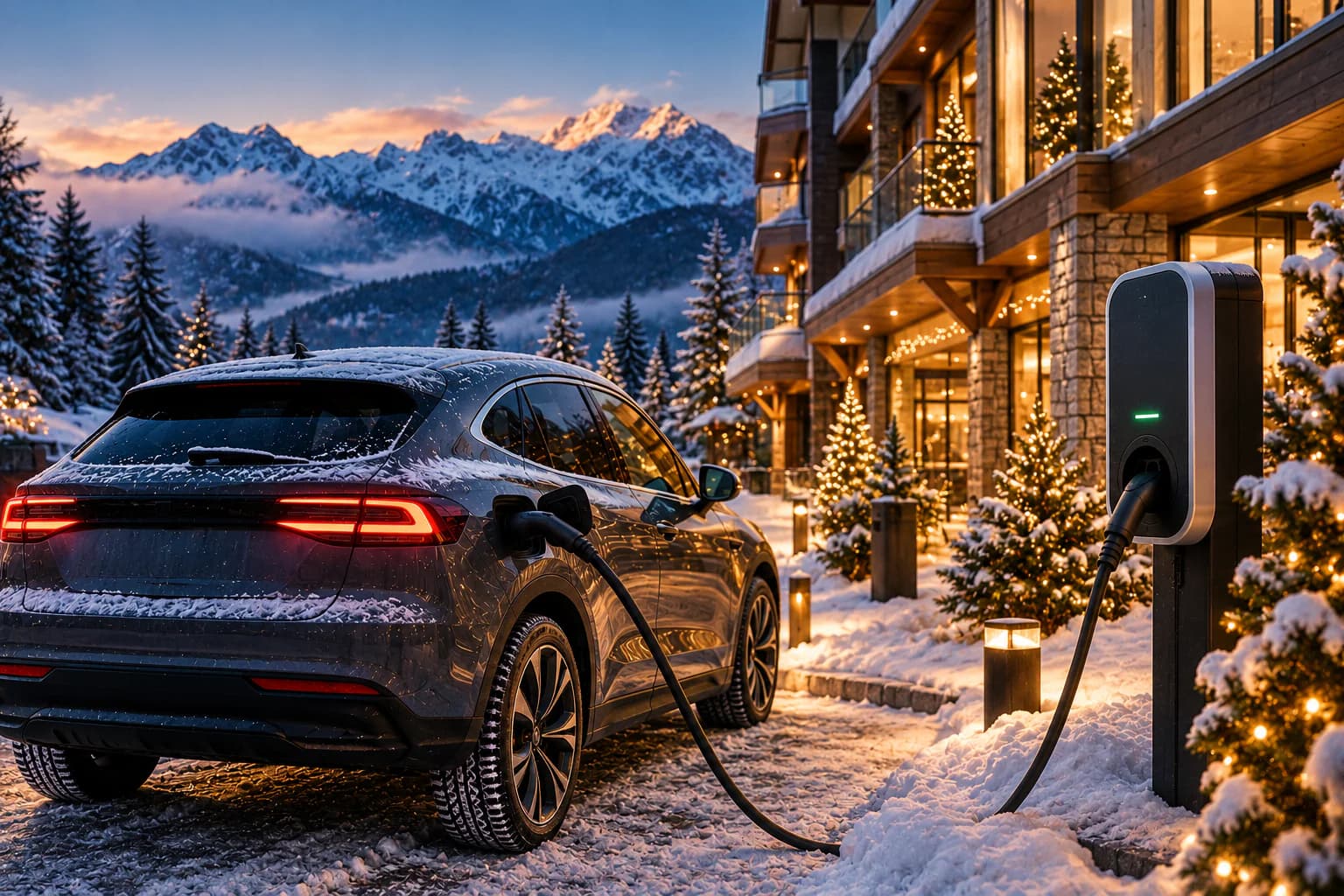
In practice, that means one thing: a hotel with a real Type 2 wallbox can give you more peace of mind than public DC at dawn. The car charges more slowly, but for many hours. The battery is fuller, and your departure depends less on queues, temperature, and whether the system has enough time to warm the pack.
We wrote in summer about a similar mechanism from the opposite angle: when the battery is overheated, overnight AC can also be more sensible than chasing another fast charge. In winter the problem is the reverse, but the conclusion is often the same: calm charging while parked beats nervously trying to make up energy in the morning.
Looking for a hotel with charging for a winter trip?
Browse stays with charging and filter properties for a real overnight stop — from Warsaw to Zakopane, Szklarska Poręba, and Kołobrzeg.
Why a cold battery ruins the plan for morning DC
This isn't about a worse charger. It's physics and battery protection. When the cells are cold, the car limits DC power so the pack isn't stressed beyond a safe range. As a result, you pull up to a fast station, see a big number on the charger, and the car still takes noticeably less.
After a night in the parking lot, especially around 0°C and below, this effect is noticeable. Sometimes very noticeable. On top of that, you have cabin heating, windows, seats, and higher consumption in the first few miles. If you're counting on a short stop and a quick jump in range, reality can easily disappoint.
For years, ADAC winter tests have shown that EV range drops in freezing weather, and that thermal comfort and preparing the car before driving have a real impact on consumption. Drivers know this from experience: the first miles in winter simply cost more energy.
What overnight AC gives you, even though it's slower
Exactly this: it's long and predictable.
If the car is parked for 8–12 hours, even moderate AC charging can add a meaningful amount of energy. You don't need peak DC numbers. You need a steady flow of energy while you're asleep anyway.
For many drivers, what's more important than how fast can I add 20 kWh is will I be able to leave in the morning without improvising. A hotel wallbox solves that second problem much better.
What usually wins in winter
- Morning DC with a cold battery
- Fast in theory, often limited in practice
- Overnight AC at a hotel
- Slower, but predictable over 8–12 hours of parking
- Benefit for the driver
- A fuller battery and less dependence on morning infrastructure
- Extra plus
- Easier to warm the car before departure while plugged in
Morning preconditioning: where a wallbox really helps
In winter, it's not just about charging itself. It's also about the morning start.
If the car is connected to AC, many models let you warm the cabin before departure using energy from the grid instead of only from the traction battery. That has two advantages. First, you get into a warm car with defrosted windows. Second, you don't start the day with an immediate drop in range from aggressively heating the interior.
That said, it's only fair to say this clearly: not every car preconditions the battery in the same way, and not every car does it while parked on AC. In some models, setting a departure time mainly helps the cabin; in others, it also prepares the pack. That's something worth knowing about your own car rather than assuming.
So a hotel with a wallbox is not a magic shortcut to full DC power after 5 minutes of driving. It is, however, a very good way to reduce winter chaos: more energy in the morning, a warmer car, and less pressure to find a fast station right away.
Driver tip
If your car has a departure schedule, set it in the evening and leave the car plugged into AC. In the morning, you gain cabin comfort and usually a better energy balance for the first miles.
Real numbers: how much overnight AC gives you during a 10-hour stop
There's no point guessing percentages for a specific model here, because battery capacities and charging efficiency vary a lot. It's better to look at energy delivered over time.
Assuming about 10 hours parked:
| AC power | Theoretical energy in 10 h | What it means in practice |
|---|---|---|
| 3.7 kW | 37 kWh | a meaningful top-up after arriving in the evening |
| 7.4 kW | 74 kWh | enough for many cars to get a very strong top-up or a full overnight recovery |
| 11 kW | 110 kWh | at this point the car itself is often the limit, not the wallbox |
| 22 kW | 220 kWh | useful only if the car supports higher AC |
These are theoretical figures, without losses and without limitations on the vehicle side. In real use, it will be less, but the conclusion stays the same: even moderate AC overnight gives you a lot. Much more than a nervous 20–30 minutes on cold DC, which in the morning may never reach the power you expected.
That's exactly why, in the Charge & Sleep search engine, it's worth looking not only at whether a hotel has charging, but also at the minimum power. The minimum kW filter helps weed out properties where charging exists more on paper than in an actual travel plan.
A real wallbox or will a regular socket do too? Not always
In accommodation listings, the word charging is often overused. For a winter trip, the difference between a Type 2 wallbox and a regular socket is significant.
A real wallbox gives you stable AC, usually a more convenient connection, and less risk that in the morning you'll discover the car charged very slowly — or not at all. Schuko can help in an emergency, but it's not the same as a hotel properly prepared for EVs.
This matters especially in the mountains, where the battery is already partly used after arrival, temperatures drop faster, and in the morning you want to leave without an extra stop.
Examples from property pages: what to check before booking
Without turning this into a ranking, here are a few practical examples from property pages:
- Nosalowy Park — check the property page for the currently listed Type 2 power.
- Stamary — same idea: what matters is real on-site AC, not a general statement about charging.
- Five Seasons Szklarska Poręba — a good example of why, for a mountain trip, it's worth checking the specific charging standard.
- Arka Medical SPA Kołobrzeg — by the sea as well, don't assume every hotel with parking has a sensible EV setup.
There are also warnings worth taking literally:
- Aries — CEE 32: that's not the same as a classic Type 2 wallbox. For some drivers it may be enough, but for many it will be less convenient and less straightforward in practice.
- Murowanica — Schuko: better than nothing in an emergency, but for a winter overnight stay before a morning departure it's usually too little if you're counting on a strong top-up.
Don't book blindly based on the phrase EV charging
If the description mentions only CEE or Schuko, treat it as plan B, not a full hotel setup for a winter trip. Ask about the connector type, AC power, number of spots, and overnight parking rules.
Checklist: how to choose EV accommodation for a winter trip
It's a short list, but it makes a difference.
1. Look for Type 2, not just a socket
First, make sure the property has an actual AC charging point for a car, not just the possibility to plug in somehow. Type 2 is the safest starting point.
2. Check the minimum power that makes sense for your stop
If you're arriving late in the evening and leaving in the morning, every hour matters. That's why the minimum kW filter in the search engine is practical, not cosmetic.
3. See how many charging spots there are
One wallbox at a large hotel can mean a queue or the need to move cars around. In winter that's especially frustrating, because everyone wants to leave in the morning.
4. Ask about parking rules and blocked spaces
The same problem keeps coming up on EV driver forums: a spot occupied by a car that's no longer charging, or by an ICE vehicle. A hotel may have a charger, but if it doesn't enforce the rules, usefulness drops.
5. Find out whether a reservation is needed
Some properties assign the charging point to a room; others work on a first come, first served basis. For a winter trip, it's better to know before you arrive.
6. Check whether the cable is your responsibility
Not every AC point has a permanently attached cable. If the hotel offers a Type 2 socket without a cable and you don't have one, you won't make up for that in the morning.
Short table: what to choose for a winter overnight stay
Overnight charging in winter: what makes sense
Better choice
- Type 2 wallbox with stated AC power
- Clear information about the number of charging spots
- The option to leave the car charging overnight
- A property that understands EV parking rules
Weaker choice
- A general claim: we have charging
- Only Schuko as the main option
- CEE without clear conditions
- No information on whether the spot can be reserved
When morning DC still makes sense
To be clear: fast charging in the morning is not a mistake in itself. It makes sense if you're staying somewhere without access to AC, you have only a short stretch to the first good station, or your car is very effective at preparing the battery before reaching an HPC.
The problem starts when the whole plan depends on an ideal scenario. That means: no queue, a working station, good pack temperature, no snow blocking the bay, and power matching expectations. In winter, that's simply too many variables at once.
That's why, for autumn and winter trips, the safer setup is simple: accommodation with AC, a morning start with a fuller battery, and DC only later — already on the road, when the car and battery are more ready to accept power.
How to search in practice: Warsaw, Zakopane, Szklarska Poręba, Kołobrzeg
If you're planning a trip from Warsaw or a destination stay in Zakopane, Szklarska Poręba, or Kołobrzeg, don't start with photos of the lobby. Start with the charging details.
Check the connector type, power, number of spots, and notes about usage rules. Only then look at everything else. For an EV driver in winter, this isn't a technical detail. It's part of the comfort of the stay, just like covered parking or breakfast from 7:00.
If you're traveling for Christmas or New Year's Eve, also take a look at our guide on how to choose a hotel with a real Type 2 wallbox in popular winter destinations: https://chargeandsleep.com/blog/swieta-i-sylwester-elektrykiem-jak-wybrac-hotel-z-prawdziwym-wallboxem-type-2-w-tatrach-lub-nad
The shortest version of the decision
- You have accommodation with a wallbox
- You charge, sleep, and leave more calmly in the morning
- You only have the promise of fast DC in the morning
- You risk a slower session with a cold battery
- The most important filter
- Type 2 and real AC power, not just the phrase EV-friendly
What I would do before a winter trip
I would choose a hotel with real AC, ideally with clearly described power and parking rules. In the evening, I'd plug in the car, set the departure time, and treat morning DC as an extra option, not the foundation of the plan.
It's less flashy than chasing the highest kW number on the charger. But it usually works better.
Check accommodation with charging before your winter trip
Filter properties by city and charging parameters. Search smart: Warsaw, Zakopane, Szklarska Poręba, Kołobrzeg.