In this article
After 8 hours of driving, no one dreams about technology. You dream about parking, plugging in the car, and going to sleep.
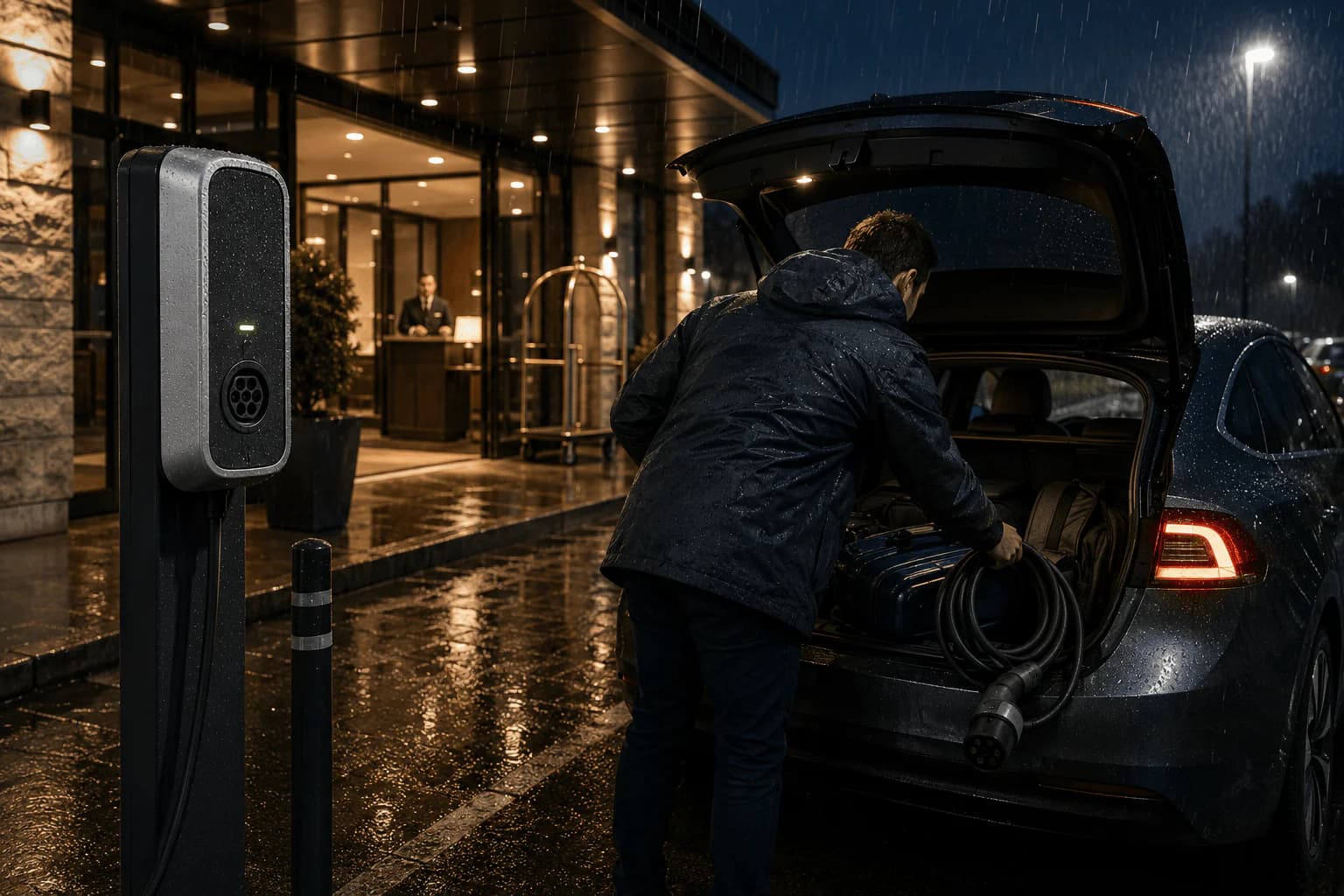
And yet that is exactly when the little hotel obstacle course begins. It is 11:00 PM. It is pouring. The hotel boasts a charger. You pull up, get out, and see that it is only a Type 2 socket with no cable. Your cable is, of course, at the very bottom of the trunk, under the suitcases. Once you finally get it out, it turns out you cannot start charging with a card from reception or a simple button. You have to download the external operator's app, create an account, and enter your payment card details.
Technically, everything works. In practice, it is a poor end to the day.
Power is only the beginning
With a hotel charger, it is easy to focus on the kW figure. 11 kW sounds better than 7.4 kW, and 22 kW sounds even better. But for an overnight stay, power alone is not always what matters most.
If you are parked for 8-10 hours, even 11 kW AC is usually enough to recover a sensible amount of energy. For many cars, that means around 60-80 kWh overnight, as long as the car can accept that power from its onboard charger. At 7.4 kW, it will be more like 40-55 kWh. The difference is real, but for a tired driver, something else is often even more important: whether you can actually start charging without a circus.
The most underrated question: how do you start the session?
This is the detail that decides whether hotel charging feels convenient or irritating.
The worst-case scenario looks like this:
- the charger belongs to a third-party operator,
- it does not work with a hotel card,
- there is no simple RFID option at reception,
- it does not accept ad hoc payment,
- it requires yet another app.
After a full day behind the wheel, you do not want to study a CPO rulebook and confirm an activation email. You want to plug in the car and disappear.
The real issue: tethered vs untethered
Hotel descriptions rarely state this clearly, and yet it is one of the most important differences.
Tethered means a charger with a permanently attached cable. You take the connector, plug it into the car, and you are done.
Untethered means just a socket. You need your own Type 2 cable.
On paper, both options "offer charging." In real life, the difference is huge.
Why a socket without a cable so often becomes annoying
Because hotel charging does not happen in a sterile showroom. It happens after a trip, at night, in a jacket, sometimes in the rain, with a child asleep on your shoulder.
If your car has the cable stored under the trunk floor, then with a full car you first have to take out the luggage. Then find the wet cable, unroll it, avoid getting your clothes dirty, and still think about where to put that cable in the morning.
A wallbox with a permanently attached cable removes most of that mess.
Hotel charging: what makes a difference after 11:00 PM
Charger with a permanently attached cable
- You plug in right away, without digging through the trunk
- Fewer problems in the rain and in the dark
- Lower risk of forgetting your own cable in the morning
- A better option for a guest staying just one night
Type 2 socket only
- Requires your own cable
- With a full trunk, it becomes unnecessary logistics
- You then have to stash away a wet, dirty cable somewhere
- Formally, there is charging, but convenience can be poor
Rain exposes every weak point
Charging a car in the rain is not a problem in itself, as long as the equipment is in good condition and designed for outdoor use. The problem is everything else.
A wet jacket. A dark parking lot. A cable dragged through a puddle. A phone you have to unlock to activate the session. Weak signal. An SMS code that never arrives.
In those conditions, a covered spot and a simple way to start charging are worth more than a few extra kW.
Do not assume a hotel charger will start right away
The mere presence of a charging station does not tell you whether you need your own cable, the operator's app, or separate registration. That is worth checking before you book, not in a downpour in the parking lot.
What the ideal version looks like
This is not about futuristic fantasy. It is about a few simple decisions on the hotel's side.
The most convenient setup for a guest looks like this:
- the space is close to the entrance and under cover,
- the charger has a permanently attached cable,
- the session is started by reception with an RFID card or assigned access,
- or it starts automatically after plugging in,
- the instructions are clear and short.
Then arrival takes two minutes. You park, plug in, see that the car is charging, and go pick up your room key.
RFID at a hotel makes more sense than yet another app
Authorization with a hotel card or a simple RFID token is still one of the best solutions. Not because it is fashionable. Because it works without having to explain half the charging market to the guest.
Reception can activate the session on the spot. The guest does not have to create an account with an external operator. They also do not have to enter card details on a small phone screen after midnight.
This matters especially for people who drive different cars, rent EVs, or simply do not want to install five apps for five overnight stays.
What about Plug & Charge?
Plug & Charge is the most elegant version of the whole process: you plug in the car and charging starts automatically, with no cards and no apps.
It sounds ideal, but in hotels it is still more the exception than the standard. There is also the question of compatibility between the car, the backend, and the charger itself. If it works, great. If not, it is good to have a plan B, ideally a simple RFID option at reception.
So it is not worth assuming that hotel charging will be as effortless as at the best DC hubs.
What really determines convenience
- Most important detail
- How the session starts, not just the power in kW
- Most convenient hardware
- A wallbox with a permanently attached cable under cover
- Least liked scenario
- A Type 2 socket only and a mandatory third-party operator app
- A good hotel standard
- RFID from reception or automatic start
Real numbers: what overnight AC charging gives you
So this does not stay at the level of impressions alone, let us look at the numbers. Assuming a 9-hour stop and typical losses, hotel AC charging can look like this:
| AC charging power | Energy recovered overnight | Approximate range recovered by morning* |
|---|---|---|
| 7.4 kW | 55-60 kWh | 280-380 km |
| 11 kW | 75-85 kWh | 380-520 km |
| 22 kW | 120-150 kWh** | depends on the car |
* Assuming consumption of around 16-20 kWh/100 km.
** Only if the car actually supports 22 kW AC. Many models will still be limited to 11 kW or less.
The conclusion is simple: for an overnight stay, 11 kW AC is often more than enough. But if starting the session takes 20 minutes and requires cable acrobatics, the whole point of hotel charging starts to fade.
What to check before booking
Do not ask only: "Is there a charger?" That is not enough.
It is better to ask specifically:
- does the charger have its own cable, or do I need my own Type 2,
- is the space under cover,
- how is charging started,
- is reception or an RFID card enough,
- do I need to download an app,
- is the charger reserved for hotel guests,
- what is the actual AC power available for one car.
One sentence that saves nerves
"When I arrive, can I simply plug in the car and start charging without an extra app?"
If the answer is vague, that is already valuable information.
Drivers do this too rarely
Before you leave, check not only the charger's power but also a photo of the charging spot. One photo usually shows right away whether there is a permanently attached cable and whether the space is out in the open.
The charging station filter still does not solve anything
This is probably the most important point for EV drivers planning an overnight stay. The charging station filter alone tells you nothing about how that charger works.
It does not tell you whether you need your own cable. It does not tell you whether activation happens through reception, an RFID card, the operator's app, or in some other not-so-obvious way. It also does not tell you whether in the morning you will be winding up a wet cable in the mud.
That is why, in practice, two hotels with the same description can deliver completely different experiences.
How to recognize a hotel that truly understands EV drivers
Not by big slogans. By the details.
A hotel understands the subject if it:
- clearly describes the type of charger,
- states the authorization method,
- tells you whether a cable is provided,
- knows how to help a guest after hours,
- treats charging as part of the service, not as a random add-on in the parking lot.
This is not luxury. It is simply a well-designed arrival.
Check how charging works before you book your stay
On ChargeAndSleep, the community looks not only at whether a hotel has a charger, but also whether you need your own cable and how the session starts. These are the details that decide whether your evening stays calm.