In this article
In summer, many drivers experience the same moment of surprise: you pull up to a fast charger, the unit shows 150 or 200 kW, and the car takes 65 kW. Or 48. Or a bit more for a moment, and then the power drops.
That is not always a problem with the station. Often, the battery temperature is to blame.
At 35°C outside, after motorway driving, with luggage, family, and the air conditioning running nonstop, the traction battery is under tougher conditions than in winter. The car's system protects the cells, so it limits charging power. And that is a good thing — but for the driver, it means a longer stop and more frustration.
What happens to the battery in hot weather
A lithium-ion battery works best within a fairly narrow temperature range. The exact values depend on the cell chemistry and the car's design, but in practice manufacturers try to keep the pack somewhere around 20–35°C. Above that range, thermal stress increases.
Fast DC charging generates heat on its own. If you add:
- hot asphalt,
- full sun,
- high air temperature,
- driving at 120–140 km/h right before the stop,
- another charging session without a longer break,
then the pack may simply be too hot to accept high power for long.
The car then reacts exactly as it should: it cuts charging power and starts more intensive battery cooling.
Why fast DC at 35°C can be hard on the car
On paper, a fast charger looks great. In practice, in summer what matters is not peak power, but the power sustained for 15, 20, or 30 minutes.
If the battery is overheated, the car will not take risks. Thermal protections will limit the charging current so as not to accelerate cell wear.
This is not a fault. It is normal battery protection.
Degradation: what it really means
Degradation does not mean the battery gets damaged by one hot charging session. The problem is more subtle: frequent combinations of high temperature and high charging power accelerate the chemical aging of the cells.
In short:
- high temperature increases the rate of unwanted reactions in the cells,
- high current during DC charging raises the thermal load,
- a high state of charge does not help either, especially if the car then sits hot for a long time.
One summer trip will not ruin the battery. But regularly putting the car through a series of hot DC charging sessions in the middle of the day is not an ideal scenario for the pack.
What raises battery temperature the most in summer
- Fast driving
- 120–140 km/h means higher energy use and more heat in the system
- Back-to-back DC sessions
- the pack has no time to return to a comfortable temperature
- Full sun
- heats the body, cabin, and makes cooling harder
- High SOC
- the last percentages charge more slowly and under greater load
DC charging power drop: where the disappointment comes from
Drivers usually look at the peak figure from the brochure. But 150 kW or 250 kW is usually reached only under specific conditions: with the right battery temperature, a low or medium state of charge, and effective cooling.
In hot weather, a real charging session may look like this:
- start at 90–120 kW,
- after a few minutes, a drop to 70–80 kW,
- with a heavily heated pack, even down to 40–60 kW.
This hurts especially when you are standing in a parking lot with no shade, while the cabin air conditioning and the battery cooling system fight for every minute of comfort.
Real-world road data
The example below does not refer to one specific model, but to the typical behavior of many modern EVs on a holiday trip:
- air temperature: 34–36°C,
- motorway stretch before charging: 180–220 km,
- arrival at the station with battery level: 12–18%,
- charger's advertised power: 150 kW,
- real power after a few minutes: 55–85 kW,
- charging time from 10–80%: 35–55 minutes instead of 25–30.
A difference of 15–20 minutes at one stop does not sound dramatic. But with two or three charging stops in a day, that turns into an extra hour of travel.
Why 11 kW AC at a hotel often beats another DC session
Overnight AC charging does not impress with big numbers. Next to 150 kW, 11 kW looks modest. But in summer, that modesty is exactly what works in the battery's favor.
With AC:
- power is much lower,
- the pack heats up less,
- the cooling system has an easier job,
- the car can charge for several hours without time pressure,
- the driver is not sitting in a hot car nervously watching the kW drop.
If the hotel has a cool covered garage or a shaded parking space, conditions get even better. The battery sheds heat more calmly, and charging stays more stable.
For many cars, 11 kW overnight realistically means 70–90 kWh in 8 hours, as long as the car and the installation support three-phase 11 kW AC. In practice, that is often full preparation for the next day of driving.
Drivers doing summer road trips
If you can choose between afternoon DC in full sun and overnight AC at a hotel, leave fast charging for necessary stops and top up the energy for the start of the day while you sleep.
A hotel with charging is not a luxury. It is a thermal strategy
In the height of summer, a hotel AC charger offers more than convenience. It gives the battery time.
When you arrive in the evening, the car is usually no longer under the same load as it was on the road. You can park, plug in, and let the system manage temperature without the pressure of a queue at the station and without another power spike.
This makes particular sense when you have 250–400 km ahead of you the next day. You start the morning with a high energy level and without needing to look for a fast charger after 80 km just because you did not want to wait the day before.
What a cool garage or covered parking gives you
The difference between a car standing in the sun and a car in a garage can be noticeable right away — for both people and electronics.
In the shade or in underground parking:
- the temperature around the car can be a few degrees lower,
- the interior does not turn into an oven,
- the cooling system does not start from such a bad position,
- morning charging or departure puts less strain on the battery.
Not every car will show this directly to the driver on a graph. But during a trip, the difference shows up in more stable charging and fewer stressful stops.
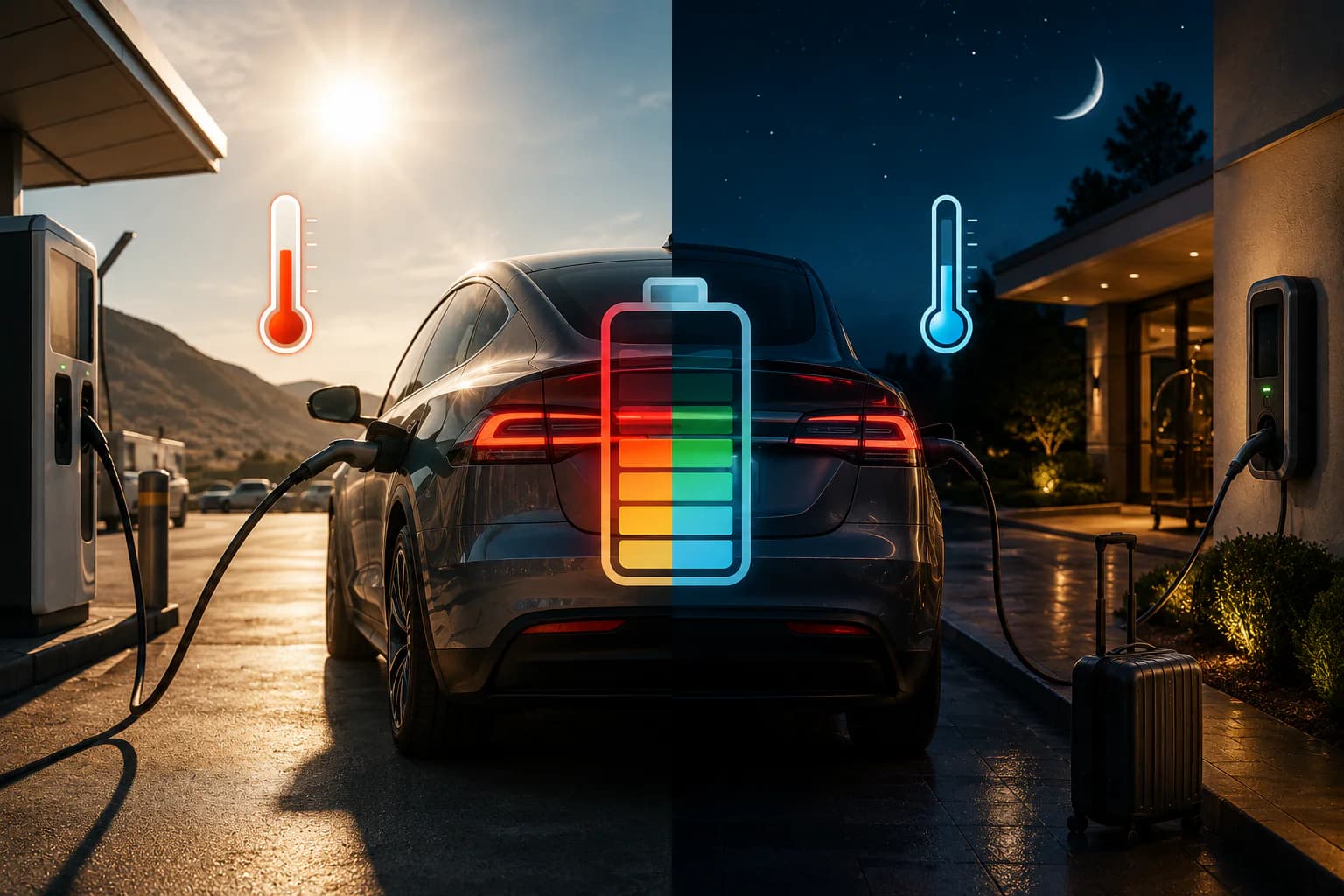
Summer stop: fast DC in the sun vs overnight AC at a hotel
Fast DC at 35°C
- high power only for a short time, or not at all
- high thermal load on the battery
- intensive cooling system and air conditioning use
- greater chance of a power drop halfway through the session
- the driver waits and keeps an eye on the car
11 kW AC overnight at a hotel
- lower but stable power for many hours
- less thermal stress for the cells
- calm pack cooling
- the car charges while you sleep
- you set off in the morning with a fuller battery
When DC still makes sense
To be clear: fast DC charging is not a bad thing. Without it, long-distance EV travel would be much harder.
The problem starts when we treat DC as the only way to charge, even for an overnight stay, despite the hotel offering AC.
DC makes sense when:
- you are on the road and need to continue quickly,
- you need to top the car up from 10 to 50–60%,
- the battery is in good thermal condition,
- the station is in the shade or conditions are moderate.
What makes less sense is charging to 90–100% at a fast station in the hottest part of the day if you are stopping for the night an hour later anyway.
Do not push to 100% on a hot DC session unless you need to
The last 10–20% charges slowly anyway, and at high temperatures the time benefit can be negligible. If you are staying at a hotel with AC, it is usually smarter to arrive there with some reserve and finish charging calmly overnight.
How to plan a summer EV trip more sensibly
You do not need to change your whole travel style. A few temperature-aware decisions are enough.
1. Treat hotel AC as part of the route
Not as an extra. If you are staying overnight after 300–500 km of driving, an 11 kW charger at the hotel may matter more than breakfast until 11:00.
2. End the day's drive with the battery in mind, not a power record
It is better to arrive at the hotel with 15–25% and plug in overnight than to fight for 90% at a fast charger at 18:00, when the asphalt is still giving off the day's heat.
3. Keep DC sessions to a sensible range
On the road, the fastest approach is usually charging roughly from 10 to 60–70%. After that, power usually drops, and in hot weather it drops even more.
4. Look for shade and give the car some breathing room
If you have a choice between two stations, the one with a canopy or in a cooler parking area may turn out to be effectively faster, even with the same nominal power.
Where Charge & Sleep makes sense in summer
This is exactly where the difference shows between an ordinary overnight stay and one well suited to an EV. It is not just about having somewhere to plug in. It is about letting the car charge in conditions that do not add more heat stress.
A good hotel for a summer EV trip is one that offers:
- reliable AC, ideally 11 kW,
- a parking space with shade or in a garage,
- clear rules for charger access,
- the option to leave the car plugged in overnight.
That often gives you more than the nearest HPC charger by a heat-soaked expressway.
Looking for a stay that really helps on an EV trip?
Choose a hotel with AC charging and ideally covered parking. In summer, that means more comfort for the driver and easier conditions for the battery.
The shortest answer
Yes — overnight AC charging at a hotel really can save both the car and your nerves in the middle of summer.
Not because 11 kW is magical. Simply because in high temperatures, the battery usually prefers calm, long charging in better conditions over another hot DC session out in the open.
And the driver would rather sleep than watch 150 kW turn into 58.