In this article
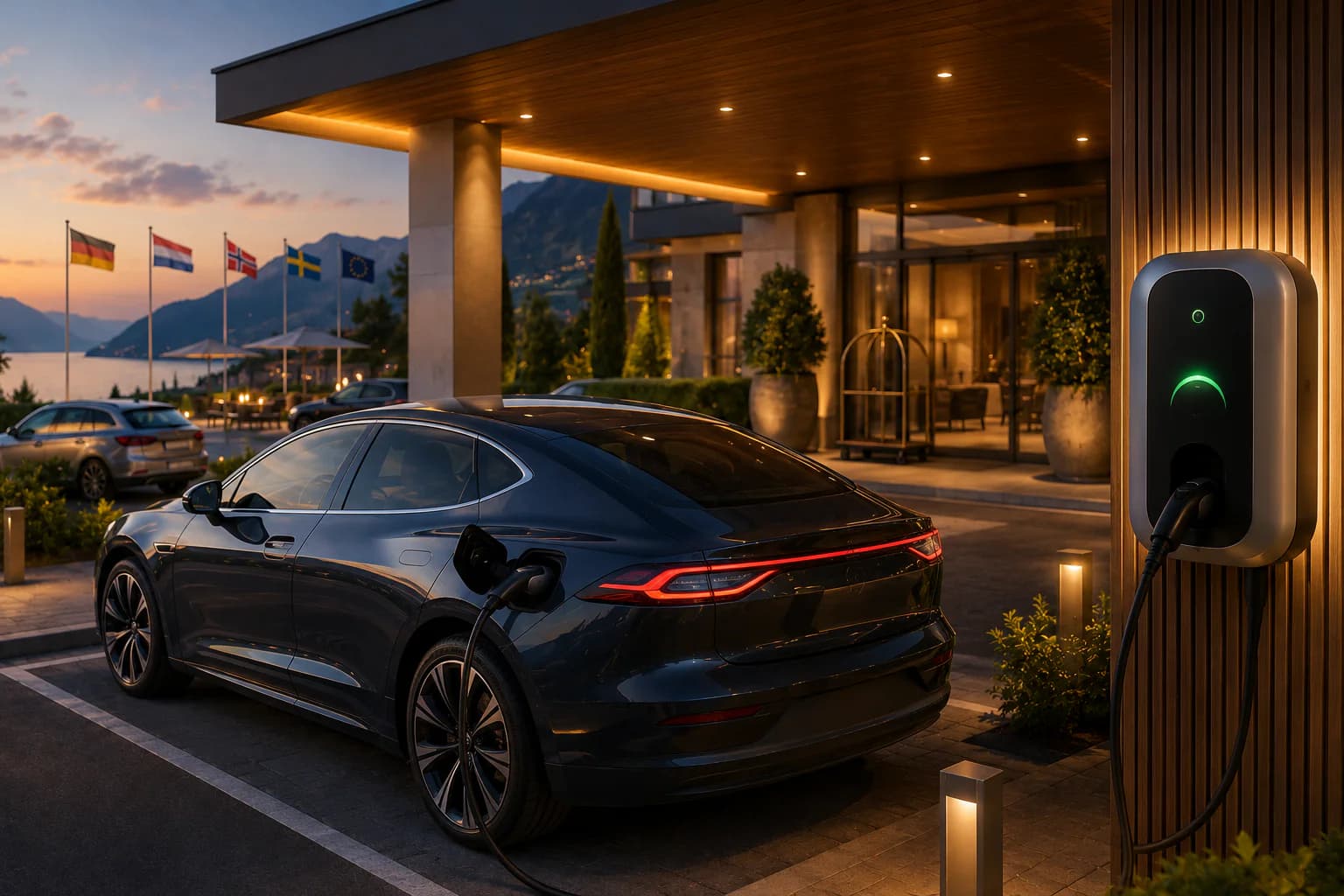
For a hotel in a transit or tourist destination, a charger is no longer just a nice parking amenity. More and more often, it is the filter that gets a property onto the shortlist.
A guest from Germany, the Netherlands, Norway, Sweden, or Denmark plans an electric-car trip differently from an internal-combustion driver. They check not only the location and room rate, but also whether they can actually charge the car overnight on site. If the answer is uncertain, they choose another property.
This matters because we are usually talking about a customer with higher purchasing power. In practice, they are more likely to book a better room, order dinner on site, use the spa, and avoid wasting time looking for a public station 8 km from the hotel.
Cross-border EV travel: what it means and why hoteliers should track it
In the EV context, cross-border travel simply means international trips by electric car: from one country to another, often across several markets and charging systems along the way.
Today, this traffic is growing especially along north-south and west-east routes. Drivers from markets with high EV adoption are heading on holiday to Italy, Croatia, Slovenia, Austria, the Czech Republic, Poland, Hungary, and further into southeastern Europe.
For hotels, this means one thing: you are no longer competing only with a property in the next town, but with every hotel on the route that can credibly present its charging infrastructure.
What really matters to an EV driver
- Booking requirement
- A working, available charger on site or right next to the property
- Minimum overnight comfort
- AC 11 kW or 22 kW over an 8-10 hour stay
- Biggest problem
- An imprecise description: a checkbox instead of data on power, connectors, and availability
- Business impact
- A better chance of booking a higher-category room and selling additional services
EV guests are often premium guests
Not every electric-car owner is a luxury customer. But statistically, this is a group with above-average purchasing power.
The reason is simple. A modern electric car, especially one used for international travel, still represents a higher entry threshold than the average combustion car. So we are often talking about people willing to pay more for convenience, predictability, and time savings.
At a hotel, this translates into very specific behavior:
- more frequent selection of superior or family rooms,
- a greater tendency to stay for dinner at the property,
- higher use of the spa, wellness area, and premium parking,
- lower tolerance for operational chaos.
If a guest has a car worth €45,000-€90,000, they do not want to negotiate with reception in the evening over whether an extension cord from the garage will also work.
Hard data: where these drivers come from
Northern and Western Europe remain the core of the e-mobility market. Norway has long been the leader in the share of electric cars in new-car sales. The Netherlands, Sweden, Denmark, and Germany are large markets where the number of EVs and plug-in hybrids already translates into real tourist traffic.
In Germany alone, millions of plug-in vehicles are on the roads, and the share of electric cars in both company and private fleets continues to expand the base of drivers planning holidays by car. The Netherlands and the Scandinavian countries also have a very strong charging-planning culture and a habit of booking accommodation around infrastructure, not the other way around.
This is not a niche. It is a segment growing alongside Europe’s HPC network and the increasing range of cars in the 350-550 km WLTP bracket. In practice, however, the driver still wants to top up the car where they sleep.
What these numbers mean for a hotel
During an overnight stay of 8-10 hours:
- an AC 11 kW charger can deliver about 88-110 kWh,
- an AC 22 kW charger can theoretically deliver 176-220 kWh, although the car often limits onboard charging power,
- for many EV models, 40-70 kWh is already enough to drive 250-400 km the next day.
From the guest’s perspective, this is the ideal scenario: arrive in the evening, have dinner, sleep, and leave in the morning with a charged car.
From the hotel’s perspective, it is selling convenience with very high perceived value.
Driver tip
If you offer overnight charging, include not only the station’s power in the description, but also the real scenario: how many kWh a guest can add during an 8-hour stay. That is a language EV drivers understand immediately.
A charger as an investment, not a side cost
The most common mistake in discussions about hotel charging is analyzing it solely through the cost of buying and installing the equipment.
That is too narrow a perspective.
Well-implemented infrastructure works in three areas at once:
- Winning bookings – the guest chooses the property because they can charge their car there safely.
- Increasing revenue per stay – they stay on site instead of driving to an external station and a nearby restaurant.
- Differentiating the offer – especially where competitors still have only a vague claim of charging available, with no details.
At many properties, just one or two additional monthly bookings from the premium segment can significantly improve the economics of the investment. Especially if the guest uses the restaurant, bar, premium breakfast, or wellness services.
Deal-breaker: no charger means losing the booking
This is the most important point.
For some international guests, the lack of a charger does not merely reduce a hotel’s appeal. It simply removes the property from consideration.
It is not even just about the presence of the device, but the certainty that:
- the station really exists,
- it works,
- it is available to hotel guests,
- it is not blocked,
- its power and connector type are specified,
- the rules of use are clear.
If this information is missing, the EV driver assumes risk. And when traveling across several countries, risk is usually avoided.
A charger icon alone is not enough
Many hotels lose bookings not because they do not have a station, but because they present it too vaguely. For an EV driver, a checkbox without information on power, connector, number of points, and access rules can be just as useless as no charger at all.
Where global OTAs fall short
Large booking platforms help with reach, but they usually treat charging superficially. Most often, it ends with a simple label saying the property has an electric vehicle charger.
That is not enough.
The driver needs to know:
- whether it is AC or DC,
- how many charging points there are,
- what the power is: 7.4 kW, 11 kW, 22 kW, 50 kW, or more,
- what connector type it uses,
- whether charging requires an app, an RFID card, or help from reception,
- whether the station is available only to guests,
- whether the space can be reserved.
Without this data, the hotel loses to a property that communicates precisely.
What a good infrastructure description should look like
Not marketing language. Operational language.
A good description should include at least:
- the number of charging points,
- the power of each point in kW,
- the connector type,
- access hours and rules,
- the billing method,
- whether the space can be reserved in advance,
- a photo of the station and its location in the parking area.
An example of a better description:
2 AC 11 kW points, Type 2 connector, available 24/7 for hotel guests, activation at reception, billed per kWh, parking space can be reserved for stays longer than 1 night.
That one sentence sells more than five generic claims about how modern the property is.
Europe is heading south and east. Who will benefit first
On holiday and transit routes, the advantage will go to the properties that understand one simple thing: an EV driver is not buying accommodation alone. They are buying accommodation with energy.
This applies especially to:
- hotels by motorways and expressways,
- holiday resorts,
- boutique properties in tourist regions,
- city hotels with underground parking,
- conference properties serving international business guests.
In transit countries, one well-described charging point can be a stronger argument than another 5% discount.
Hotel with a charger vs hotel without one
Property with verified infrastructure
- Makes the EV driver’s shortlist already at the route-planning stage
- Has a better chance of securing a higher-category room booking
- Keeps the guest on site for dinner and additional services
- Builds an advantage in international traffic
Property without infrastructure or with an unclear description
- Gets ruled out despite a good location
- Loses to competitors that are more operationally predictable
- Gives away revenue to restaurants and stations outside the property
- Remains invisible to some premium guests
What to do before the season
You do not need to build a large charging hub right away.
For many hotels, a sensible starting point is 2-4 AC 11 kW or 22 kW points in the overnight parking area. This solution fits the nature of a hotel stay well, where the car stands for several hours.
If the property mainly serves one-night or several-hour transit stays, it may also be worth considering faster DC charging. Here, however, the decision depends on connection capacity, guest profile, and local economics.
First, answer three questions:
- Where do your guests come from, and how often do they travel by car?
- How many hours does the car stay parked on average?
- Can you clearly present the infrastructure in your sales channels?
If the answer to the third question is not entirely, then the problem may already be not a lack of equipment, but a lack of proper presentation.
ChargeAndSleep.com: a place where the charger is not just a checkbox
This is where a specialized platform comes in.
ChargeAndSleep.com allows hotels across Europe to present their charging infrastructure precisely: power in kW, connector types, availability, and practical conditions of use. This matters because these are exactly the details drivers look for when planning trips between countries.
The platform is available in English, German, and Polish, so it meets the needs of international premium guest traffic. For a property, this means a simpler way to present its offer to drivers from Germany, Austria, the Netherlands, or Scandinavia who want to know exactly what to expect on arrival.
If a hotel already has a charger, it is worth verifying it and describing it properly. If it is only just implementing one, it is worth preparing the data from the start so it supports sales rather than disappearing under a generic filter on a global OTA.
Add or verify your hotel on ChargeAndSleep.com
Show drivers from across Europe the real charging parameters at your property and open your doors to premium guests this season. Property registration is free.
A hotel that understands the needs of the European EV driver is not just selling a room. It is selling a stress-free stage of the journey. And that is something a well-off international guest is happy to pay for and return to when everything works without guesswork.