In this article
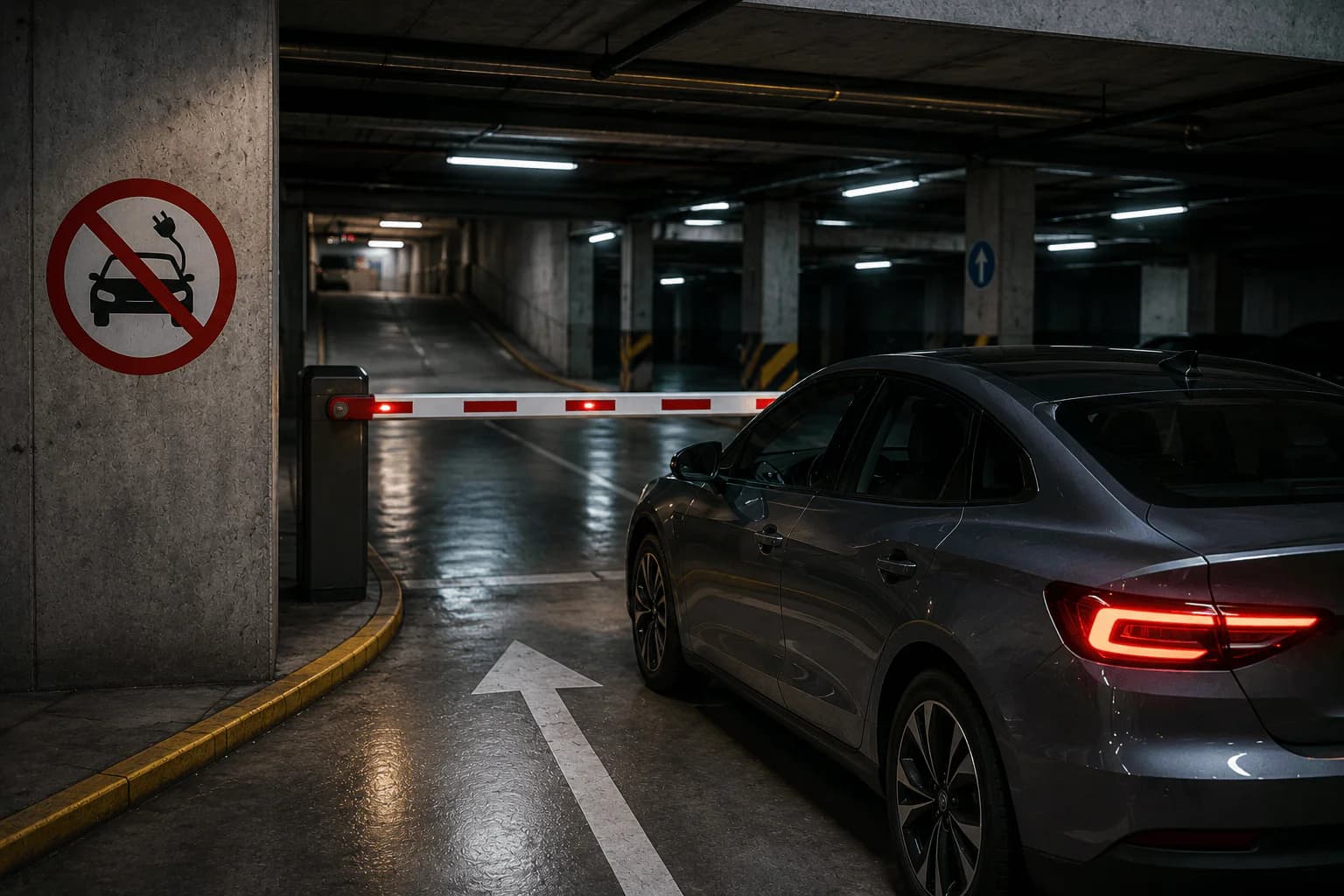
After 400 km behind the wheel, nobody wants to argue at the barrier with reception, security, and a printout from the internet. And yet it happens: a hotel has underground parking, sometimes even boasts about a charger, but still refuses entry to an EV because someone decided it is unsafe.
The problem is real. But very often it does not stem directly from regulations. It comes from overzealousness, poor interpretation of guidance, or plain fear after high-profile stories about battery fires.
First, the fact: EVs do not catch fire more often than combustion cars
This is the key point, because most bans start here. The myth goes like this: an electric car is a greater fire risk than a petrol or diesel car, so it is better not to let it into an underground garage.
The data does not support that.
Real data
According to statistics from the Polish State Fire Service, the number of electric car fires in Poland is negligible compared with fires involving combustion cars. We are not talking about a difference of a few percent, but orders of magnitude. Petrol and diesel cars simply catch fire far more often.
That is logical, too. The combustion-car fleet is still enormous, and there are more ignition sources: fuel, oils, high exhaust-system temperatures, LPG systems, makeshift electrical repairs, and vehicle age.
What the numbers show
- Combustion-car fires
- In Poland, they are counted in the thousands each year
- Electric-car fires
- These are single cases or at most dozens, not thousands
- Conclusion
- The claim that EVs catch fire more often does not hold up against State Fire Service data
That does not mean battery fires do not exist. They do. They can be more operationally difficult for firefighters, may require longer cooling, and involve different procedures. But that is not the same as saying EVs catch fire more often. That claim simply does not stand up.
So where do bans on entering underground garages come from?
Most often, from three sources.
1. Overzealousness by a homeowners’ association or building manager
In mixed-use buildings, apartment blocks, and hotels, decisions are sometimes made just in case. One person reads an article about a single fire, someone else adds their own interpretation, and in the end a prohibition sign appears.
Without a risk analysis. Without consulting a fire safety expert. Without checking whether such a ban even makes sense in that specific building.
2. Outdated or poorly read fire safety guidance
In some properties, managers refer to internal procedures or old interpretations concerning underground garages. The problem is that precautionary recommendations are not automatically a universal ban on every EV.
Sometimes the issue is that the fire safety instructions were never updated after chargers were installed. Sometimes the building has no clearly described rules for parking and charging, so the easiest answer is simply no.
3. Lumping EVs together with LPG vehicles
This is a common absurdity. At the entrance there is a no-LPG sign, and next to it EV is added, as if both cases followed the same technical logic.
They do not.
Restrictions for cars with gas systems have their own technical and historical background. Automatically extending them to electric cars is usually a shortcut in thinking, not a sound risk assessment.
Can a hotel refuse entry to an electric car in its garage?
In practice, yes, if it has set such rules for its property. That is bad news for the driver, because at the barrier there is usually no room left for debate.
But the ability to set rules on private property is one thing, and claiming that the ban follows from an obvious state of knowledge or from general law is another. Very often, it does not.
If a hotel advertises underground parking or charging and then refuses entry to EVs, that is not safety-mindedness. It is an information mess. For the guest, it means exactly one thing: stress, lost time, and looking for a Plan B at night.
The worst-case scenario after a long drive
You have 12% battery left, you arrive at a hotel booked for overnight charging, and on site you hear that EVs are not allowed into the garage. A surprise like that wrecks the whole travel plan and should not happen at a properly described property.
EV safety in a garage: what makes sense and what is just fear
A sensible approach is not to ban everyone. It is to have procedures.
It makes sense when a hotel:
- knows exactly where the charging spaces are,
- has working ventilation and standard fire protection systems in line with the building design,
- uses certified AC charging stations, usually 11 kW or 22 kW,
- trains staff on what to do in the event of an alarm,
- distinguishes between parking an electric car and improvised charging from a random socket.
It does not make sense when a hotel:
- bans all EVs from entering while having no issue with hundreds of combustion cars in the garage,
- advertises itself as EV-friendly but will not let you past the barrier,
- explains the decision with a single viral video from the internet,
- cannot say whether the ban applies to parking itself or only to charging.
Charging and simply parking are not the same thing
This is also worth separating. Some properties are afraid of charging, but not of parking an EV itself. If a hotel has a regular parking space in the garage and does not allow charging from a 230 V socket, that is still understandable.
But if the ban covers simply driving an electric car into the underground garage, you have to ask what it is based on. Because that is where it usually turns out to be more about emotion than real requirements.
Drivers: ask about two separate points
Before booking, ask separately about EV access to the garage and separately about the possibility of charging. In many hotels these are not the same thing, and reception can mix them up.
What a hotelier should do before putting up a ban
If you run a property, do not copy signs from the building next door. Check the facts first.
The minimum of common sense on the hotel side
- Verify whether the ban comes from a real analysis of the property or from a common opinion.
- Consult a fire safety expert if the building has an underground garage and plans to serve EVs.
- Clearly describe the rules: parking, AC charging, maximum power, and charger location.
- Train reception and security staff. A guest must not hear three different versions from three different people.
- Update the hotel website and booking confirmations.
This is not a minor detail. For an EV driver, information about garage access and charging can be just as important as breakfast hours.
How to check a hotel before clicking Book
Do not assume that a charger icon settles the matter. Unfortunately, it does not always.
Short checklist
- Does the hotel state the charging power, for example 11 kW AC or 22 kW AC?
- Is the charger in the underground garage or in the outdoor car park?
- Can EVs enter the garage normally?
- Does the space need to be reserved in advance?
- Does charging work via an app, RFID card, or through reception?
- Are there time limits or a parking fee after charging ends?
If reception answers uncertainly or avoids a simple yes, EVs can enter, treat that as a warning sign.
Where Charge & Sleep makes a difference
This is exactly where a community helps, not just a directory with a list of plugs.
On paper, many hotels look good: there is parking, there is a charger, there are photos. The problem only starts on site. That is why, for drivers, not only the connector type and power matter, but also whether the property applies absurd entry bans or surprises guests with its own interpretation of safety.
ChargeAndSleep highlights such cases and helps catch them before booking. That saves nerves, time, and emergency charging searches with 8% battery left.
A well-described hotel vs. a trap for EV drivers
Prepared hotel
- States whether EVs can enter the underground garage
- Describes charging power, for example 11 kW AC
- Has consistent information on the website and at reception
- Distinguishes parking from charging
Problematic hotel
- Boasts about parking but says nothing about an EV ban
- Cannot confirm the rules by phone
- Mixes up the LPG ban with a ban on EVs
- Surprises the guest only at the barrier
Our assessment: an automatic ban is a bad standard
Not every garage and not every property is identical. That is clear. But an automatic ban on all electric cars is not a sign of professionalism today. It is a sign that someone has not done their homework.
And a driver after a long trip should not have to pay for someone else’s fears and organizational chaos.
If a hotel wants to serve modern guests, it has to provide clear rules. If it does not want to allow EVs into the garage, it should say so plainly before booking, not reveal it at the entrance. Honest information is the absolute minimum.
Check the hotel before you get stuck at the barrier
At ChargeAndSleep, we look at more than just power and plug type. We also flag properties that surprise drivers with absurd entry bans. Better to know before booking than after 500 km on the road.