In this article
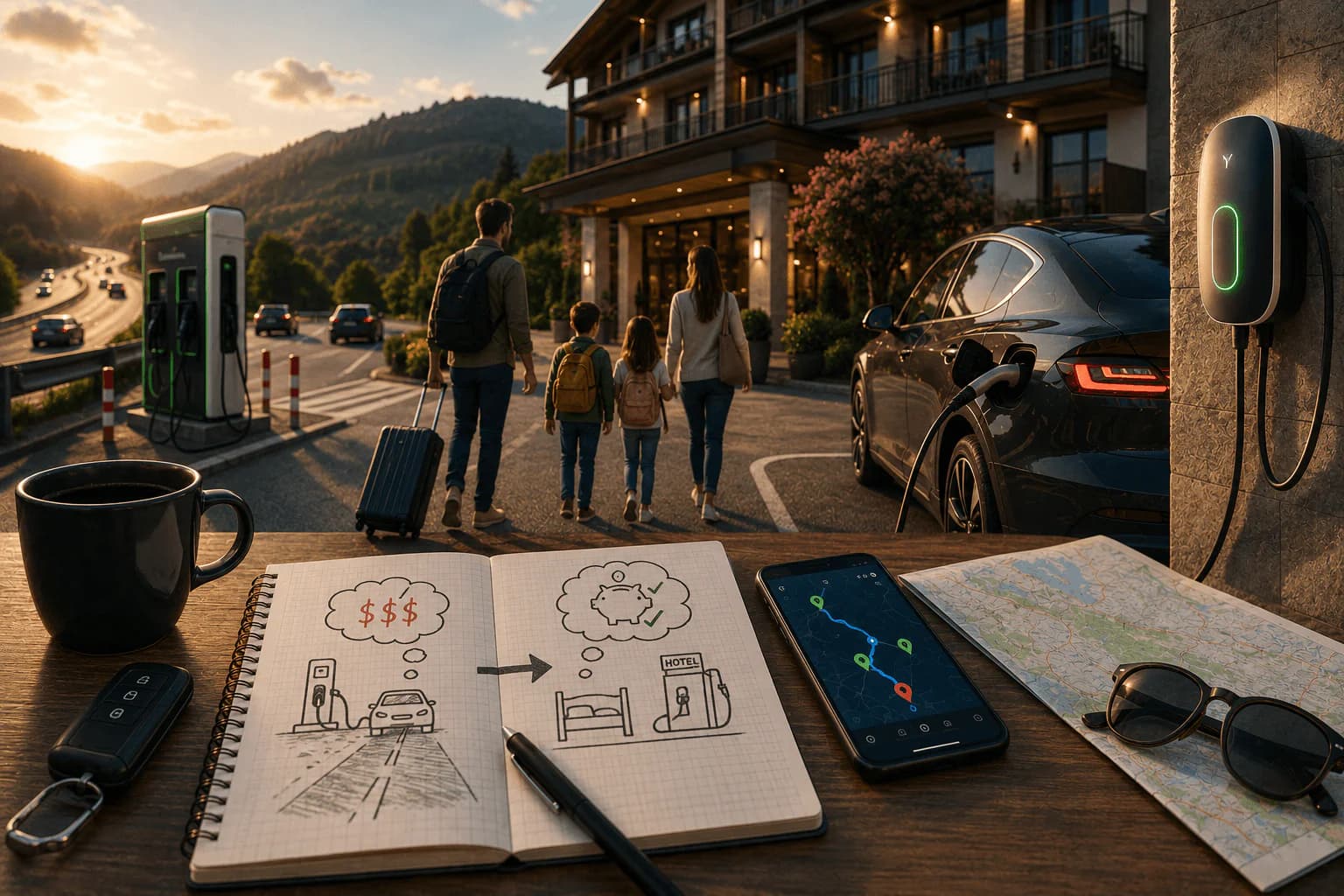
The most expensive electricity on holiday is often not at the hotel, but at the motorway
What usually drives up the cost of an EV trip is not the accommodation itself, but charging on the road. Especially fast DC charging at motorway stations, bought without a subscription and without a plan.
A simple number:
- 60 kWh at a fast charger at around PLN 2.5/kWh
- means PLN 150 for a single charging session
If you make two such stops during a holiday journey, that becomes PLN 300. And that is already enough to change whether the whole trip still feels cost-effective.
For many drivers, this is where the disappointment starts. Day to day, the car is cheap to run, but a holiday route can add several expensive DC sessions to the budget. And suddenly, the cost of travelling by EV no longer looks as good as it does in the city.
Quick calculation: where the high bill comes from
Let’s assume a fairly typical scenario:
- the car averages 18 kWh/100 km
- the one-way holiday route is 500 km
- the trip requires about 90 kWh of energy
You may have some energy from home, but in practice, on a longer route there is usually at least one larger charging session along the way. If you top up 60 kWh at a motorway charger, you pay about PLN 150. If you need more, or return the same way, the cost rises very quickly.
With two such sessions:
- 2 × 60 kWh
- 2 × PLN 150
- total PLN 300
This is not an unusual case. It is ordinary holiday maths.
Why a hotel with charging changes everything
Now the other side of the equation. You stay overnight at a hotel that has destination charging, usually AC or a wallbox.
Then you usually get one of three pricing models:
- charging is included in the room price
- the hotel charges a flat fee, for example PLN 50 per night
- energy is billed separately, but at a fair rate, usually lower than at a fast roadside charger
And this is where a practical life hack appears, one that really works: instead of buying expensive electricity on the go, you book accommodation where the car charges while you are sleeping anyway.
You do not lose time on an extra stop. You do not stand by a charger next to a petrol station. In the morning, you leave with a fuller battery and a smaller bill.
The same trip, two different costs
Let’s take a simple example.
Option 1: cheaper hotel, but no charging
- room: PLN 400
- charging on the road at DC: 60 kWh × PLN 2.5 = PLN 150
- total: PLN 550
Option 2: hotel costs PLN 100 more, but charging is included
- room: PLN 500
- hotel charging: PLN 0
- total: PLN 500
The result is simple: the more expensive hotel turns out cheaper.
And if the hotel charges a flat fee, for example PLN 50 for the whole night, the calculation is still often favourable:
- room: PLN 500
- overnight charging: PLN 50
- total: PLN 550
So exactly the same as in the option with the cheaper hotel and expensive motorway charging. Except here you also gain convenience and extra energy in the morning.
Where the difference becomes biggest
You save the most when:
- you travel in peak season and prices at chargers on main routes are high
- you do not have a subscription that lowers the DC rate
- your car has a larger battery and you are happy to take on 40–60 kWh overnight
- you plan several overnight stays on the way or a road trip with multiple stops
- you travel with family and do not want to add separate stops just to charge the car
In practice, the cost of EV charging on the road hurts most when it is bought as an emergency and without an alternative. A hotel with sensible infrastructure gives you exactly that alternative.
Ionity, GreenWay and other fast chargers: when they make sense
This is not about saying fast chargers are bad. They are often essential. The problem starts when they become the only plan.
Comparisons such as Ionity vs GreenWay interest drivers for a reason, because price lists, subscriptions and extra fees can vary a lot. But from the point of view of a holiday budget, something else matters most: every expensive DC session you can avoid usually improves the final bill.
So if you have a choice between:
- topping up 50–60 kWh at a motorway charger at a high rate
- or spending the night somewhere the car charges more slowly, but more cheaply
many times the second option will be better financially.
How much you can realistically save
Let’s calculate conservatively.
Assume two overnight stays during a longer trip:
- each night the car takes about 40 kWh
- together you get 80 kWh of energy
If you bought that same energy at a fast charger at PLN 2.5/kWh:
- 80 kWh × PLN 2.5 = PLN 200
If the hotel offers charging for free, that PLN 200 stays in your pocket.
If it charges a flat fee of PLN 50 per night:
- 2 × PLN 50 = PLN 100
- savings compared with the motorway: about PLN 100
And that is without counting time. And time also has a cost, even if you do not put it into the spreadsheet.
A simple EV trip cost calculator
You do not need a complex spreadsheet. You only need to calculate four things:
1. How much energy you will use
Formula:
- distance in km × average consumption in kWh/100 km / 100
Example:
- 600 km × 18 kWh / 100 = 108 kWh
2. How much energy you have at the start
If you leave home with a nearly full battery, part of the cost is already behind you, usually at a lower price than on the road.
3. How much you will buy at expensive DC chargers
This is the most sensitive point in the budget. This is exactly where motorway charging prices come in.
4. How much you can shift to the overnight stay
If the hotel lets you add 30, 40 or 60 kWh overnight, you subtract that energy from what you would otherwise have to buy on the road.
This kind of simple EV cost calculator often leads to one conclusion: it is not always worth looking for the cheapest room. It is better to look for the cheapest full package: accommodation plus energy.
What to watch out for with hotel charging
Not every listing that says parking with a charger means the same thing. Before booking, check:
- whether charging is included in the price or paid separately
- whether there is a flat fee, a per-kWh fee, or perhaps a parking fee
- how many charging points there are and whether they need to be reserved in advance
- what the AC charging power is
- whether the charger is available only to hotel guests
- whether the staff actually know how access to the charger works
This matters because large booking portals often show only the information that a property has charging, while pricing details are buried deep in the terms and conditions or missing entirely.
And for a driver, that is not a minor detail. It is part of the travel bill.
Free hotel charging does not always mean unlimited
It is worth asking one thing: does free hotel charging mean complete freedom, or rather a helpful bonus within reasonable limits?
Some properties really do offer electricity with no extra charge. Others are happy for you to top up overnight, but with a large battery or several cars in the car park, they may introduce limits. That is normal.
So it is best to look for places where the rules are described clearly:
- free with no extra conditions
- fixed fee per night
- billed by meter
Transparency matters more here than marketing slogans.
Cheap EV travel is not only about choosing the operator
Many drivers start by comparing operator price lists. Fair enough, because the differences can be large. But the real saving often does not come from choosing a slightly cheaper fast charger. It comes from not doing one or two expensive sessions at all.
That is exactly what an overnight stay with charging included does.
It changes the cost structure:
- you spend less on the most expensive electricity
- you take more energy where you are stopping for the night anyway
- it is easier to plan the next day without nervously searching for a free charger in the morning
When a hotel with charging may not pay off
There are also situations where the saving will be small or none at all:
- you stay only briefly and will not have time to charge the car meaningfully
- the hotel has only a standard socket, not a wallbox
- the charging rate at the property is close to public AC pricing and does not offset the higher room price
- you are driving a route where you will need a fast stop anyway regardless of the overnight stay
In that case, it is worth calculating everything calmly, without assuming that every hotel charger automatically means savings.
The most sensible strategy for a holiday trip
A simple setup works well:
- start from home with a high battery level
- one short DC stop only when it is really needed
- an overnight stay somewhere you can charge the car calmly
- leave in the morning with replenished energy
This is usually the best compromise between time, cost and convenience. Not always the fastest on paper, but often the cheapest in the real budget.
Where to check for hidden savings
The biggest problem today is not that there are too few hotels with charging. The problem is that too rarely do you know on what terms that charging actually works.
On large booking portals, the information is often sparse. Sometimes you only see a charger icon. The electricity price is hidden in the terms, added in small print, or missing entirely.
That is why, before booking, it is worth checking a place where drivers and hoteliers themselves report the specifics: whether charging is free, flat-rate, or billed by meter.
On ChargeAndSleep.com, that is exactly what matters. Not just the presence of a charger, but the real cost and how it works in practice on site. If you are calculating your trip budget, check the map and look for those hidden savings before choosing an apparently cheaper overnight stay.
Sometimes the difference is a few dozen zloty. Sometimes more than a hundred. And sometimes it is simply a calmer morning without hunting for a fast charger by the road.
Next trip
Compare hotels before you lock dates
Browse hotels with power and connector filters. EV Trust and stall specs when we have them.